

Featured Categories
Loading...
“The Li10 team’s expertise in automated systems and laser welding, coupled with their commitment to quality and cost-effectiveness, has been instrumental in successfully launching and maintaining multiple projects across numerous production lines.”
Learn how laser welding works, where it fits, how it compares to MIG and TIG welding, and how Li10 helps manufacturers evaluate, install, and support laser welding systems.
Quick answer: Laser welding uses a focused, high-intensity laser beam to melt and fuse metal at the joint, creating a narrow, deep, and clean weld. Compared to arc welding, it delivers faster travel speeds, a smaller heat-affected zone, minimal distortion, and welds that often need little or no post-processing.
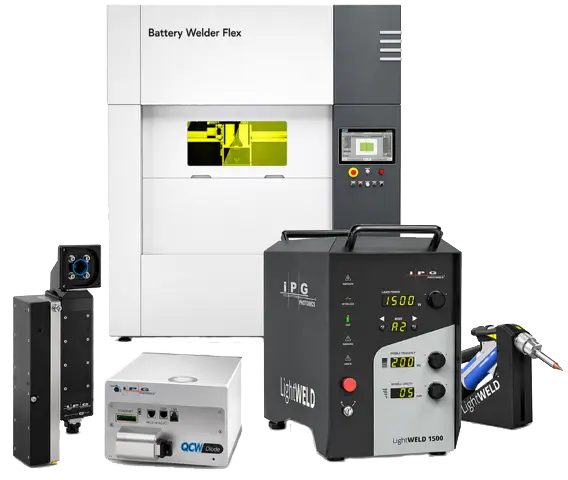
The details: The laser beam, typically generated by a fiber laser source from manufacturers like IPG Photonics and Coherent, is delivered through a fiber-optic cable to a welding head, which can be handheld, mounted on a cobot, or integrated into a full robotic cell. Most fiber laser welders run between 1.5 kW and 6 kW and can join steel, stainless, aluminum, copper, and dissimilar metals.
Quick answer: For most thin-to-medium gauge fabrication, 0.5 mm to roughly 8 mm, yes. Laser welding is 4 to 10 times faster than MIG or TIG, produces a smaller heat-affected zone, virtually no spatter, minimal distortion, and welds that usually need no grinding.
The details: A handheld fiber laser welder, like the IPG LightWELD systems Li10 offers, can replace MIG or TIG on many light-to-medium fabrication tasks. The right answer is rarely "replace everything." It is usually "add laser to the line and route the right jobs to the right process."
Quick answer: Yes. When parameters are dialed in correctly, laser welds match or exceed the tensile and fatigue strength of comparable MIG and TIG welds, often with better consistency.
The details: Strength depends on joint design, parameter control, shielding gas, focus, speed, and the operator or program running the system. For load-bearing or safety-critical parts, the key question is whether every weld can be proven consistent. That is where inline weld monitoring becomes important.
Quick answer: Laser welding melts both base materials together to form a metallurgical bond. Laser brazing melts only a filler wire at lower temperatures, allowing it to flow into the joint and bond the parent metals without fully melting them.
The details: Choose laser welding when you need maximum joint strength. Choose laser brazing when joining dissimilar metals, working with thin gauges, preserving coatings, or creating a clean cosmetic seam. Li10 helps customers choose the right process for each joint.
Quick answer: Most shops pay back a handheld or cobot laser welding investment in 6 to 24 months. Savings come from faster welding, reduced consumables, less rework and grinding, lower training time, and increased throughput.
The details: A simple ROI model starts with current weekly welding labor hours, fully loaded labor rate, and the percentage of work that could shift to laser. Li10 builds custom ROI models using your actual part mix, labor rates, and production volume.
We use cookies to improve your experience. Privacy Policy.


